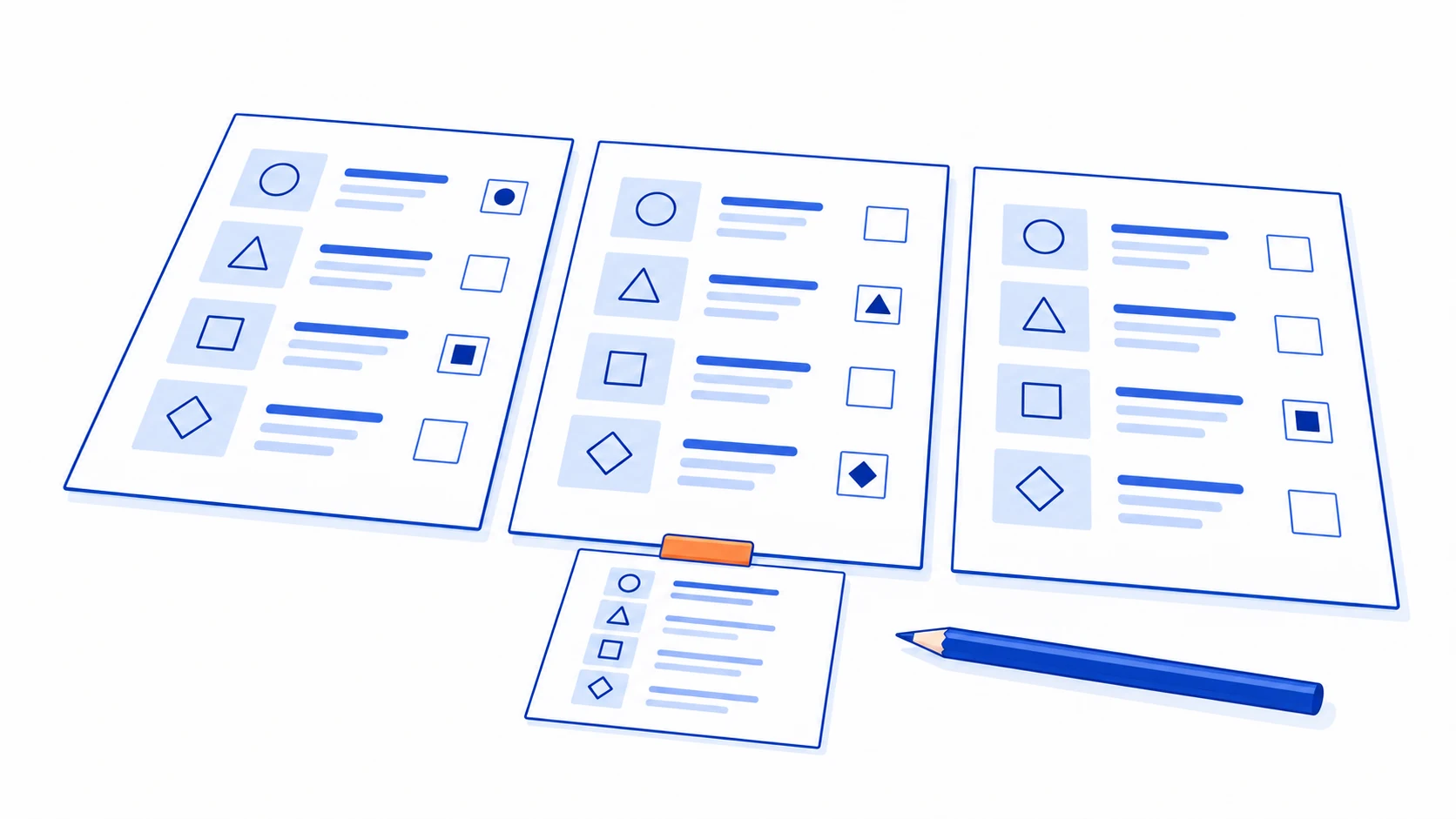
Choosing between OpenAI, Anthropic and Google starts with the task your product must complete. A provider name is too broad to be the unit of comparison. The useful candidate is a particular model, accessed through a particular service, with a defined configuration and operating agreement.
Consider an illustrative distributor building an assistant that turns Thai customer messages into draft service requests. It must preserve product codes, distinguish a reported fault from a confirmed diagnosis, request missing details and prepare the correct fields for the service team. A fluent answer is only one part of that job. The model must also know when the evidence does not support an answer.
Define the product boundary before comparing models
Write the input and output contract first. In this example, inputs include a message, an optional product photo and a permitted view of the customer's purchase record. The output contains a product identifier, reported symptoms, missing information and a proposed next step. Creating an actual service booking is a separate action with its own permission and confirmation.
This boundary avoids a misleading demonstration: one candidate receives cleaned text while another must interpret a blurry photo; one is allowed to search purchase history while another sees only a message. Decide which work belongs to document extraction, retrieval, business rules and the model. Then compare candidates on the same responsibility.
Also distinguish a staff chat subscription from the API or managed service used inside your product. They may have different billing, administration, data handling and supported features. An employee's experience in a chat application is useful feedback, but it is not evidence that the corresponding product integration meets your requirements.
What to verify with each provider
OpenAI's model selection documentation makes task type, quality, latency and cost relevant to selection, and notes that availability and tools depend on the product and model version. Record the actual model and settings used in your trial rather than writing only “OpenAI” in the decision sheet.
Anthropic documents structured outputs for constraining response format, with compatibility and schema limitations. If your product needs structured service-request fields, test the exact schema and endpoint you intend to use. A successfully parsed response still needs business validation.
Google's structured output guide similarly distinguishes valid structure from valid values. Its guidance explicitly calls for application checks on semantic correctness. A model can return a neatly formed product code that does not exist in your catalogue.
| Decision area | Evidence to collect | A weak substitute |
|---|---|---|
| Task quality | Correct fields, appropriate uncertainty and useful next actions | A polished paragraph |
| Thai and English | Actual customer wording, mixed language and domain abbreviations | Translated generic examples |
| Tool use | Correct tool, arguments and handling of its result | A promise that an action was done |
| Product fit | Required modality, endpoint, access controls and data terms | A provider's general feature list |
| Operating effort | Latency, failures, review time and recovery | Token price alone |
These checks apply to all three providers. They are not claims that one provider always wins a category. Features and models change; the comparison should remain reproducible when a candidate changes.
Run a trial that can reveal a bad choice
Build a small but representative set of historical requests that you are permitted to use. Remove unnecessary personal information. Include ordinary requests, unclear photos, conflicting product codes, missing purchase records and messages that ask for something outside the product's remit. Have the service team define acceptable outputs before seeing model answers.
Separate development examples from a held-out set. Use the development set to improve prompts and tool descriptions. Use the held-out set to check whether the improvement generalizes. Repeatedly tuning against every example can make a weak product look dependable.
Run a controlled baseline first, with equivalent information and output requirements. Then allow each candidate a reasonable, documented configuration adjustment. Some settings are provider-specific; fair comparison does not mean forcing identical parameters that have different meanings. Keep both results so the team can see the effect of tuning.
Review outputs without provider labels where practical. Record the type of failure, not just a single aggregate score. Missing a harmless formatting preference and booking a visit against the wrong customer record should not cancel each other out in an average. Repeat important cases to observe variability instead of relying on one fortunate response.

Measure the cost of an accepted task
For the distributor, a useful unit is a service request the team can accept with the intended level of review. Count model usage, document processing, retrieval, tool calls, retries and the staff time spent correcting mistakes. A low-cost response can become expensive if it creates another conversation with the customer.
Measure the complete user wait, including retrieval and downstream systems. Check typical response times and slower cases under realistic concurrency. A responsive model cannot fix a purchase-history service that repeatedly times out, and switching models will not address that bottleneck.
A fallback provider is another product configuration to test. Confirm that it can receive the same data under your agreements and that its output meets the same contract. Avoid silently changing providers after a tool has already created a booking: first reconcile the action's status. Redundancy is useful only when the fallback preserves the workflow's meaning.
Keep a decision record that survives the next model release
The final record should name the chosen endpoint, model configuration, trial date, dataset version, unacceptable failures and the person responsible for review. State why the result fits this task, which limitations remain and what event triggers a retest. A model update, a new input format or a change in business policy can each justify one.
You can use more than one model when the routing rules are explicit and tested. For example, straightforward field extraction and difficult evidence reconciliation may have different requirements. Start with a working baseline, however, so additional routing has a measurable benefit rather than adding hidden complexity.
If the work belongs in a broader team tool, also consider how to structure a shared AI workspace. If the buying decision is still open, compare the product scope against buying, connecting or building software.
Talvyn Labs can turn your real requests into a model trial and a working AI product scope. Bring representative inputs and the result your team needs to accept. We can define the evaluation, connect the required data and build the workflow around the selected model, including the cases that need a person to decide.
Choose the model around the work your AI product must deliver
Bring real inputs to Talvyn Labs. Test provider options, define acceptable results and build the workflow that connects your business data and tools.
Build your business AI product