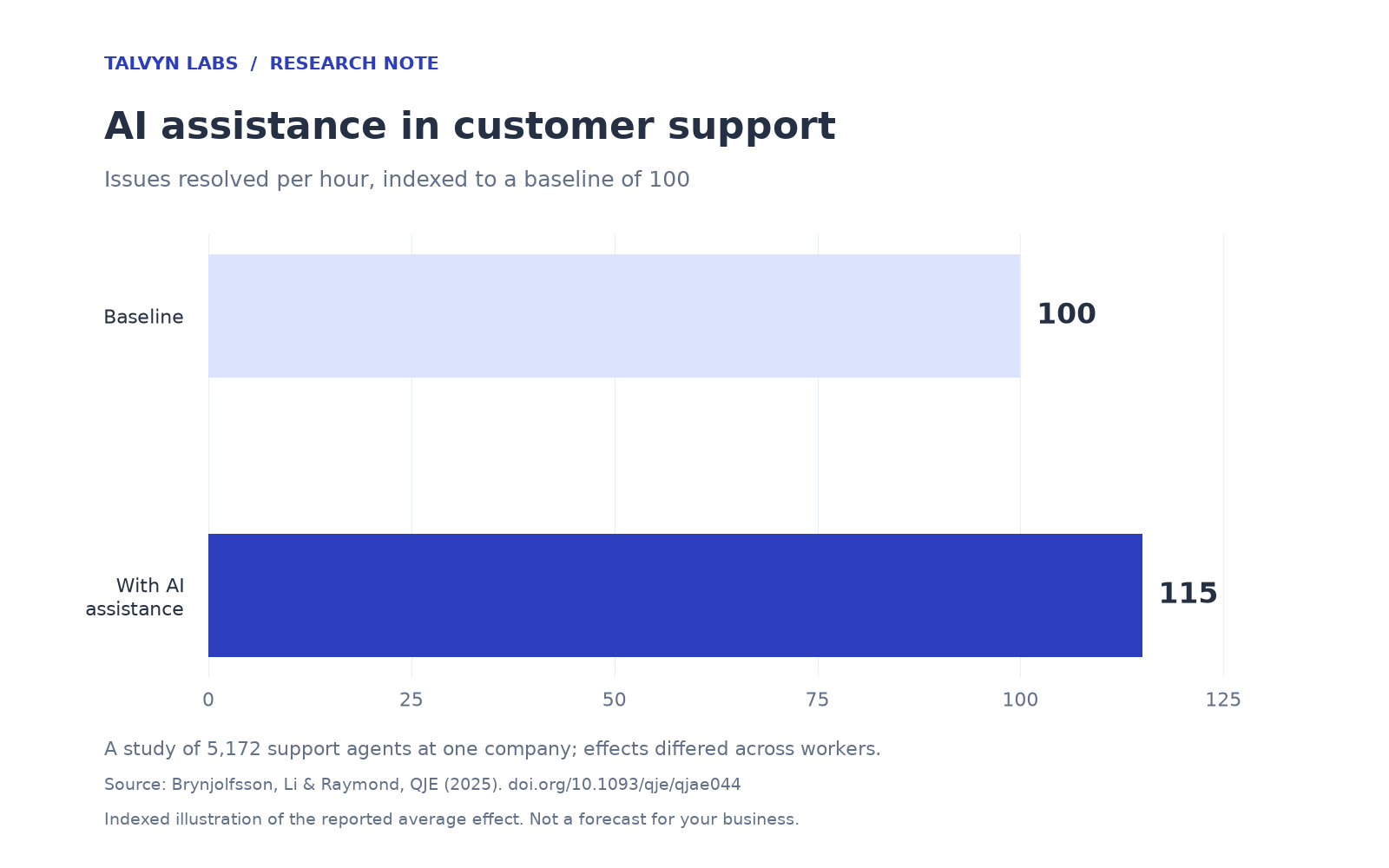
Cover: An original chart of the study’s reported average effect, indexed to 100 for readability. These are not raw case counts or a Talvyn performance forecast.
A new employee receives a customer question and asks a manager which product fits, whether a particular condition is allowed and how the last similar case was handled. The manager knows the answers. When several colleagues ask at once, the team starts waiting for the same person.
The business may already have documents. The difficulty is knowing which version applies, whether it is current and where this customer’s exception is recorded.
AI can bring reviewed knowledge closer to the work, helping people find information, summarise context and prepare a response. The goal is a team that can continue with confidence, with a clear handoff when a decision needs authority.
Evidence from customer support
Generative AI at Work, published in QJE in 2025, studied 5,172 support agents at one company. AI assistance increased issues resolved per hour by 15% on average, with larger benefits for less experienced workers.
That result supports testing comparable work in your own setting. It does not mean every company will gain the same increase in revenue or profit.
The OECD’s 2025 SME report adds another perspective: among AI-using SMEs that had experienced a skills gap, 39% reported that AI helped compensate for it. This is cross-country survey evidence, not an experiment establishing an effect for Thai SMEs.
For a business owner, a useful question follows: where does work stop while someone waits for knowledge that already has a checkable answer?
Choose knowledge that can support a decision
Start with repeated questions and a clear information owner: service conditions, product details, intake requirements or handoff procedures. Include examples and explain when the guidance applies.
A salesperson selecting a product might receive relevant information and a draft explanation. A special discount or customer commitment should still go to the person authorised to approve it. In service work, an assistant might locate an approved initial check and escalate when the situation does not match the procedure.
Expertise that exists only in someone’s memory needs capturing and review before it becomes an AI source. Old conversations may contain outdated guidance, one-off agreements or conclusions that were later corrected. Treating all of them as standard answers would blur those distinctions.
Follow one question into an actionable handoff
Consider a hypothetical customer who wants to change a product they previously bought. The employee should see the history they are allowed to access and the approved product information.
AI could summarise what is known and identify missing questions, such as the intended use or an installation constraint. Once the context is sufficient, it could prepare a response with its sources for review. A special condition should travel to the appropriate person with the context already gathered.
After the case, record whether the suggestion helped and what needed changing. Updating a shared policy needs an information owner; editing one response should not automatically rewrite company guidance.
This journey defines an AI product or agent more clearly: its inputs, allowed sources, proposed output and approval point before it affects the customer.
Put assistance where the team works
If a team works in CRM, relevant information or a draft beside the customer record may be more useful than repeatedly copying context into another tool. Design access and the data supplied to AI around the user’s responsibilities.
The Talvyn Custom CRM demo illustrates an AI order draft and response with separate edit, confirm and send controls. It provides a way to discuss review responsibilities. A company-specific knowledge system and production connections need their own agreed scope.
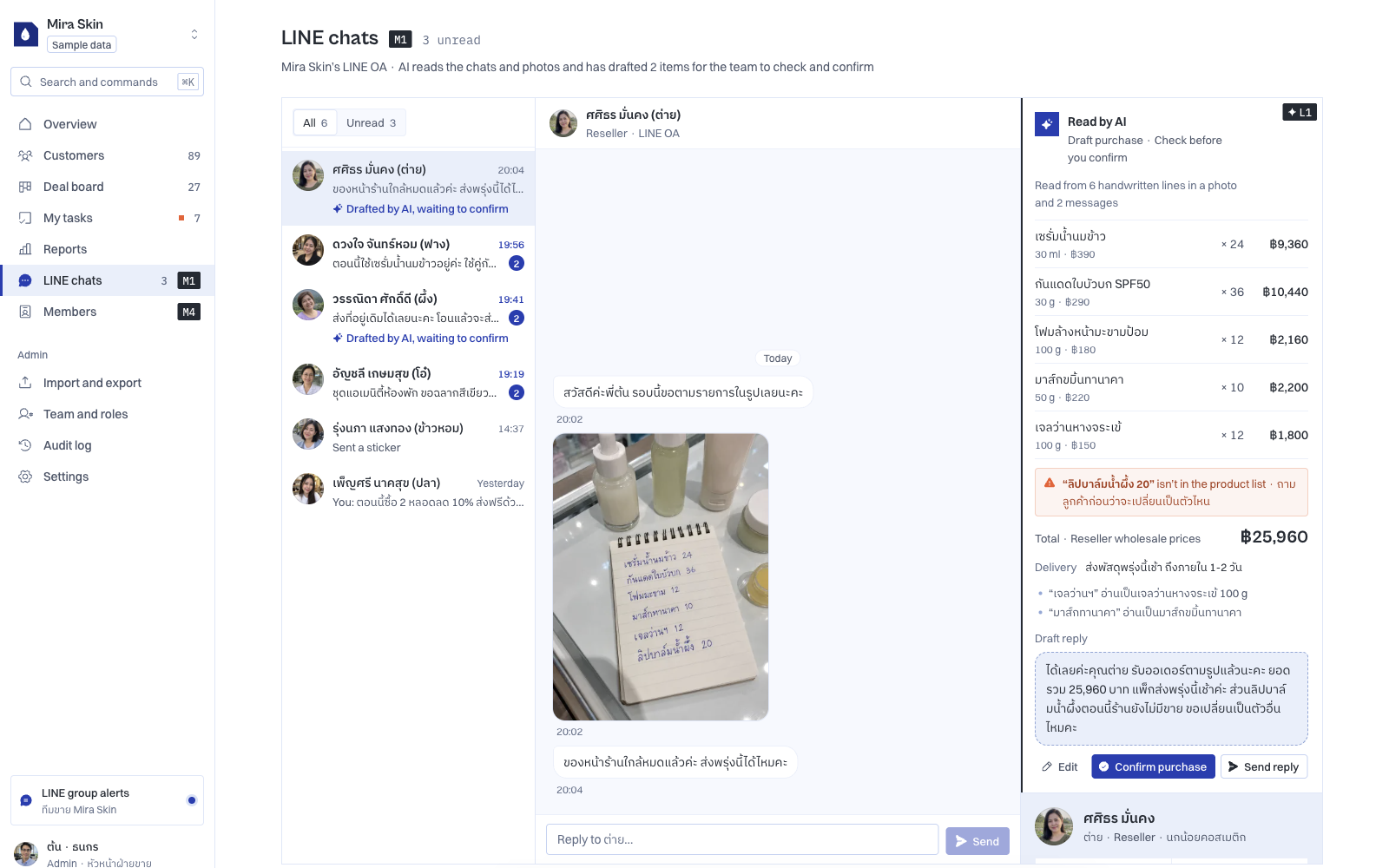
The NIST Generative AI Profile recommends checking sources and citations in AI output. Give reviewers a way to inspect the supporting information and flag a mismatch with the case.
Measure whether the team can continue the work
Choose measures from the problem: requests for expert help per case, corrections to draft answers and whether handoffs contain enough information. Compare cases of similar difficulty.
Fewer questions to a manager are not progress if customer answers become less accurate. Better answers may also require additional review time, which belongs in the assessment. Include quality, time and the work needed to maintain the knowledge.
Turn expertise into a system your team can work with
If growth still depends on how many questions an owner or manager can answer, start turning that expertise into a shared working system. Talvyn Labs helps scope AI products and agents around business processes, including CRM connections, information sources and approval points. Bring recurring team questions and reviewed examples to define the system and the outcomes worth measuring.
Discuss your AI product or agentRelated reading
References
- Brynjolfsson, Li & Raymond (2025): Generative AI at Work, The Quarterly Journal of Economics.
- OECD (2025): Generative AI and the SME Workforce.
- NIST (2024): Generative Artificial Intelligence Profile, NIST AI 600-1.
- Talvyn Custom CRM demo, an interface example rather than business-outcome evidence.